
Watch On-demand Demo Video

You're being redirected to the video.
What ZF expects from the SYNAOS Intralogistics Management Platform
Technology company ZF is using SYNAOS to optimize its intralogistics. Two pilot projects in Friedrichshafen are running successfully, and the software is now to be rolled out globally.

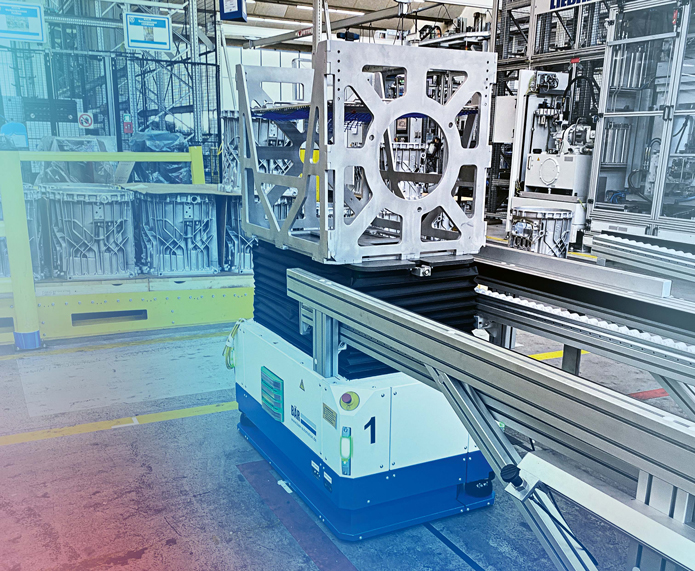
As a globally active technology group, ZF provides systems for the mobility of cars, commercial vehicles and industrial technology. The company's products and their manufacture must now be adapted to the future. This entails tremendous complexity. In order to be fit for the future, production must be well organized, and intralogistics plays a prominent role in this. ZF is already using automated vehicles to deliver components from the warehouse to production, to transport goods to distribution warehouses or to transport empty boxes. In doing so, the company uses solutions from various hardware providers. “In order to be more flexible and manage this heterogeneous system efficiently, we decided to invest in the use of Synaos's Intralogistics Management Platform,” says Tomasz Mazur, SAP Development Manager at ZF's Czeóstochowa site in Poland.
High Expectations
The company is hoping for several major benefits from working with SYNAOS: First, the use of the Intralogistics Management Platform — IMP for short — should fundamentally make processes more efficient. Second, the software is intended to supplement the milkrun principle practiced so far at ZF with utilization-oriented supply concepts. Milkrun combines several collections and deliveries in one cycle. However, ZF has found that the intelligent use of many short transport routes would be more economical instead. That is exactly what you can do with IMP. SYNAOS software calculates, prioritizes and coordinates the most efficient routes overall. It even makes it possible to introduce matrix productions that do not require any clocked lines. ZF intends to revolutionize intralogistics with SYNAOS.
“When it comes to the path into the future, it is important that the partner wants to go down this path with us.”
Thirdly, through intelligent automation, ZF wants to make intralogistics more attractive as a workplace: After all, the use of software eliminates repetitive tasks. “Intralogistics activities are becoming more demanding. We train our employees for these more exciting tasks. That is why the works council supports the introduction of the SYNAOS Intralogistics Management Platform (IMP),” says Harald Gärtner. At ZF, he is responsible as coordinator for the implementation of fleets consisting of driverless transport vehicles (AGVs). “When it comes to the path into the future, it is important that the partner wants to go down this path with us. The conditions are right for ZF and SYNAOS. We have a shared vision,” says Gärtner.
He was also convinced of the ability to use the software globally, as well as the VDA 5050 as a standardized interface for communication between driverless transport systems (FTS). The 57-year-old also appreciates the support offered by SYNAOS. Harald Gärtner sees his role in implementing the new technology as a kind of Scrum Master: He coordinates the processes and supports the sites during implementation. However, the projects themselves are then implemented at the individual locations.
ZF is testing the use of the software in Friedrichshafen with two pilot projects with up to twelve FTFs. They run extremely well and have convinced Gärtner, especially since one project involves complex matrix production. In the future, SYNAOS software will be used at all ZF locations worldwide. “We have now set the framework for this,” says Gärtner. It is now important to include all employees in the process as well. “We are now only investing in automated processes and will be able to integrate 250 to 300 vehicles worldwide every year in the next four or five years,” says Gärtner. What ZF and SYNAOS are implementing together here is a model for the Smart Intralogistics Revolution that could set a course.

Join 1,000+ Intralogistics insiders who receive insights directly via email.


