Watch On-demand Demo Video

You're being redirected to the video.
Between Brownfield and Greenfield: How Volkswagen Bratislava Is Future-Proofing Its Body Shop
In Short
Volkswagen Slovakia (VWSK) automates the material supply of the body shop at its Bratislava plant with 43 automated guided vehicles (AGVs) from Asseco CEIT. Four different robot models work as one fleet, dispatched by the SYNAOS Intralogistics Platform via the VDA 5050 interface standard and connected to Volkswagen's own IT system.
Since the step-by-step rollout began in 2023, VWSK reports a material flow automation level of 85 percent.
Auf einen Blick
- Customer: Volkswagen Slovakia (VWSK), Bratislava plant, Devínska Nová Ves
- Area: Hall H6b, body shop for the Skoda Superb and the VW Passat
- Fleet: 43 mobile robots from Asseco CEIT in four models: forklift AGVs 1500FCB and 1500FS, underrun AGVs 1200F and 1500UDS, Since shooting the film in 2025, a second production hall has gone live, which brings the total fleet to 89 AGVs.
- Communication Interface: VDA 5050
- Result: Material flow automation level of 85 percent


Northwest of Bratislava, the idyll of greenhills at the foot of the Little Carpathians meets intralogistics excellence.This is the district of Devínska Nová Ves, home to the Volkswagen plant Bratislava. It is one of the most versatile car plants in Europe and can boast several superlatives. Around 12,300 employees build vehicles for Audi, Porsche,Seat, Skoda and Volkswagen on a site the size of almost 250 football fields.
Step into Hall H6b, the body shop for the Skoda Superb and the VW Passat, and another superlative reveals itself, along with anauthentic glimpse into the future of automotive production. In-plant material transport in the body shop has been handled by mobile robots since 2023.That makes this plant one of the most modern in the world and the most innovative within the Volkswagen Group. How do manual staging and automated AGV transport work together?

How do manual staging and automated AGV transport work together?
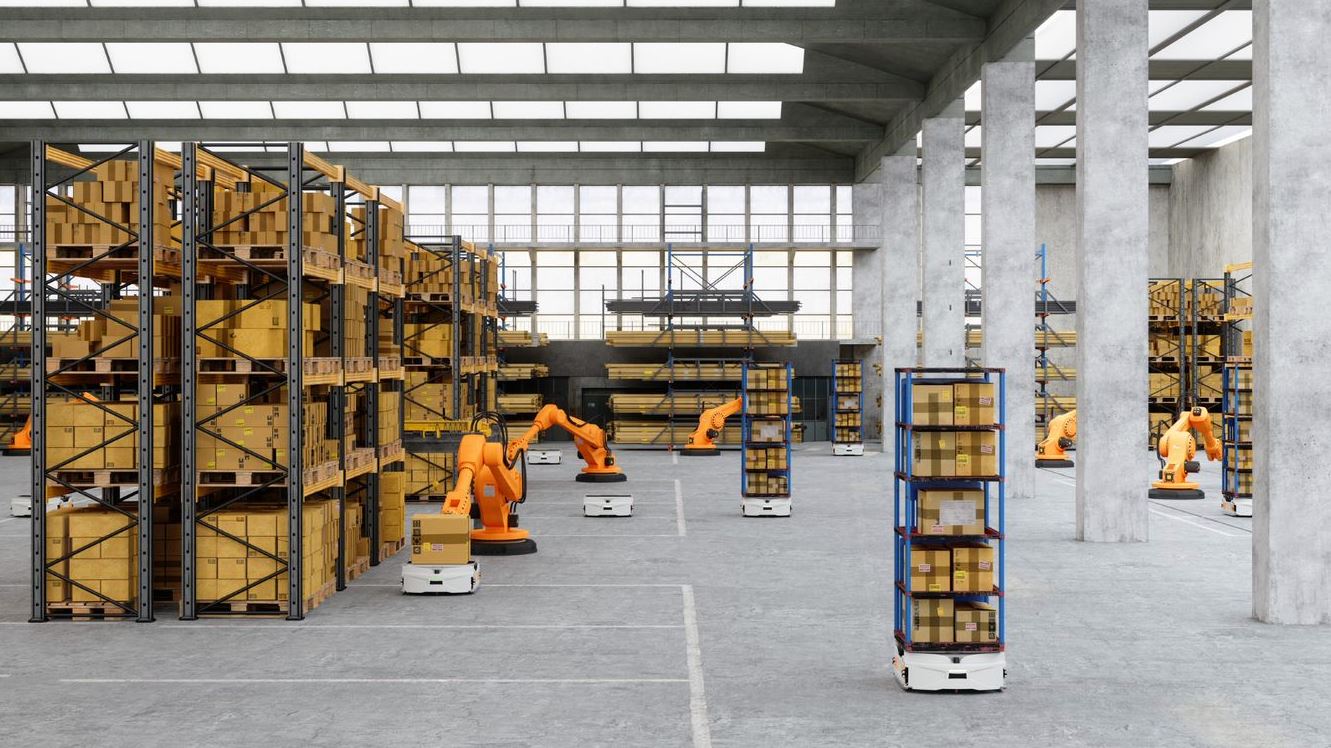
The robots operate across almost the entire hall floor. Their first port of call is a dedicated handover area. Several trucks from logistics partner DHL deliver the material needed for the body shopevery day, and DHL forklift drivers unload them. They take the material to the adjacent high-bay warehouse. Based on real-time consumption data from production, a Volkswagen IT system assigns transport orders to the drivers as needed. They pick the material from the racks and stage it in the handover zonefor pickup by the mobile robots.
From here, the yellow-and-black tunnel and forklift robots from manufacturer Asseco CEIT take over. The SYNAOS software, which isin turn connected to the Volkswagen system, has dispatched them in good time. Flashing, they approach the handover zone with care and rotate into position. Depending on the load carrier, the underrun AGVs drive beneath the pallets,while the autonomous forklifts pick up the white plastic containers with their forks.

How did Volkswagen Slovakia reach an automation level of 85 percent?
"The logistics processes in our body shop are highly complex and highly technological," says Ronald Müller. As Project Manager for New Vehicle Projects at Volkswagen Slovakia (VWSK), he is responsible for automating intralogistics processes such as autonomous transport and the automated staging of body parts. Automation solutions, he says, must be built into the planning from the earliest phase of any new vehicle project. The aim was to automate the material flow in the body shop with autonomous mobile robots and to control it intelligently through software."
"Only if I do efficient, robust layout and process planning that takes the automation potential into account can I put a good automation solution, arobust process, in place."

Since 2023, Müller's team has gradually deployed 43 mobile robots from the Austrian/Slovak manufacturer Asseco CEIT, because logistics at VWSK faces enormous cost pressure and high demands foradaptability. Today, Müller looks back on a success story: "This is the first time we have truly proven that kind of adaptability in a project. Despite the different designs of the robots, we have built an efficient,well-structured fleet. Since integrating the SYNAOS software and the CEIT AGVs,we have achieved an automation level of 85 percent."
From plan to live operation: how VWSK ramped up its mixed AGV fleet step by step
"Using our software platform hassignificantly increased efficiency and flexibility at this site," says Dr. Wolfgang Hackenberg, CEO and founder of SYNAOS, who was involved in the project from the start. "We ramped up step by step, because we work with partners who still handle some logistics processes manually. That means we have handoverpoints where manual processes take place. All of that had to settle in over the course of the project."
The fleet manager of the SYNAOS Intralogistics Platform made a significant contribution to this success.
For the first time, the fleet manager gave VWSK's automation team the ability to connect the various intralogistics assets efficiently with one another. Since then, the team has had alive view of everything: the locations, routes, charge levels and orders ofeach individual robot.
Four models from robotics specialist Asseco CEIT, two different tunnel AGVs and two forklift AGVs, hum across the smoothfloors of the hall. Though "hum" isn't quite right. In live operation, every one of the yellow-and-black AGVs plays made-up tunes through abuilt-in speaker. "That's for occupational safety," explains Günther Meyringer, CEO of CEIT.
A greenfield project at a brownfield site
VDA 5050 is an open interface standard from the German Association ofthe Automotive Industry (VDA) and VDMA that defines how AGVs and AMRs communicate with a central fleet control system. Asked about the challenges of this automation project, Meyringer says: "The first is simply the size of the hall we're working in. It's dozens of football fields. The second is the sheer number of drop-off and pickup stations for our AGVs. In total, we had to implement more than 200 stations. The third major source of complexity is the types of material: the different body parts that we have to transport."

The standard, he says, is a decisive means of carrying out projects like this one successfully. "VDA 5050 is more than a technological standard. It is a means of professionalizing mobile robotics projects," says Hackenberg, "because it allows the partners to be orchestrated better. And no matter how many robots we're talking about in the future, we need exactly this professionalization. Robots need reliable information about their environment, such as map layouts. This is where the emulation of our software comes in. We can look at different scenarios digitally at a very early stage and carry out a digital commissioning." This capability, he says, is essential at greenfield sites.
“VDA 5050 is more than just a technical standard. It is a tool for professionalizing mobile robotics projects”—Dr. Wolfgang Hackenberg
How to prepare an AGV automation project: upfront analysis, simulation and emulation
Günther Meyringer agrees. For logistics decision-makers who are (or are being asked to) consider automation, herecommends a solid upfront analysis early on to define the exact goals:" For example: How many and which processes should be automated? Which materials should be transported? And, as was done in this project, a dynamic simulation. A driving simulation lets you identify many problems and weakpoints in good time.
When choosing software, you should then make sure it is highly functional. It's not just about moving something from A to B. You also have to achieve a very good integration with upstream warehouse systems. And SYNAOS is certainly one of the best solutions on the market for that."
Why one platform for AGVs from multiple manufacturers pays off
By now, the machine colleagues from CEIT, controlled by SYNAOS, are delivering tangible value on the shop floor in Hall H6b.
"The SYNAOS platform gives us full transparency over all existing orders, in real time and in one place. We can track when an individual robot started a transport order or whether it is delayed," reports Juraj Danielovits, IT Logistics Planner at VWSK. "And the fact that we can control AGVs from multiple manufacturers together on one platform is extremely economical and matches our vision of a forward-looking automation strategy."
Outlook: highly connected intralogistics, deeper automation
Mobile robotics, meanwhile, is advancing rapidly, and customer requirements are the biggest driver: "Especially in the areas of safety and efficiency. The robots no longer work only with LiDAR scanners but also with 3D cameras for obstacle detection. And they will be able to travel faster and faster. Integration with software providers such as SYNAOS is also playing an ever bigger role. VDA 5050 is a must in almost every tender," says CEIT CEO Günther Meyringer.
The future of automotive production, says Ronald Müller, will be shaped by cost pressure, volatile supply chains and disruptive competitors. "In ten years' time, I believe our intralogistics will be highly connected. It will be digitized and automated to a large extent,and we will see more and more automation solutions." At VWSK, he adds, there are still many opportunities to become more efficient and even more flexible.
"If you leave the site," adds Dr. Wolfgang Hackenberg, "and look further into the future, there will beother forms of automation as well. Robotics keeps evolving and is not only mobile but also humanoid. These are the major trends he sees in the industry. We will see more flexibility and the site will remain a leader on these topics in the future."
------------------------------------------
In Short
How many robots does Volkswagen Bratislava use in its body shop?
43 mobile robots from Asseco CEIT have been gradually put into operation since 2023 in Hall H6b, which handles body construction for the Skoda Superb and VW Passat. They serve over 200 drop-off and pick-up stations. Since the turnaround in 2025, another hall has been put into operation; as of October 2026, 89 mobile robots from various manufacturers are in use.
Which AGV models run at Volkswagen Slovakia?
As of filming: Four Asseco CEIT models: the forklift AGVs 1500FCB and 1500FS and theunderrun AGVs 1200F and 1500UDS. The different load carriers for body partsmade four models necessary.
Which software controls the AGV fleet at VWSK?
The fleet manager of the SYNAOS Intralogistics Platform. It is connected to the Volkswagen IT system and gives the team a live view of locations, routes, charge levels and orders of every robot.
What role does VDA 5050 play in the project?
The robots are orchestrated via VDA 5050 by the SYNAOS central fleetcontrol management. CEIT converted all of its software components from proprietary software to VDA5050. CEIT CEO Günther Meyringer reports a productivity gain from this and saysVDA 5050 is "a must in almost every tender".
Can one platform control AGVs from different manufacturers?
According to Juraj Danielovits, IT Logistics Planner at VWSK,controlling AGVs from multiple manufacturers together on one platform "is extremely economical and matches our vision of a forward-looking automation strategy". The fleet in Hall H6b combines four CEIT robot models.
How do manual processes and AGVs work together at VWSK?
DHL forklift drivers stage material in a handover zone based on transport orders from a Volkswagen IT system. The SYNAOS software dispatches the AGVs, which pick up the material and deliver it to the body shop.
How should companies prepare an AGV automation project?
Günther Meyringer recommends an early upfront analysis: define which processes and materials to automate, run a dynamic driving simulation, and choose software that integrates well with upstream warehouse systems. Wolfgang Hackenberg adds that software emulation allows a digital commissioning beforego-live.
Join 1,000+ Intralogistics insiders who receive insights directly via email.